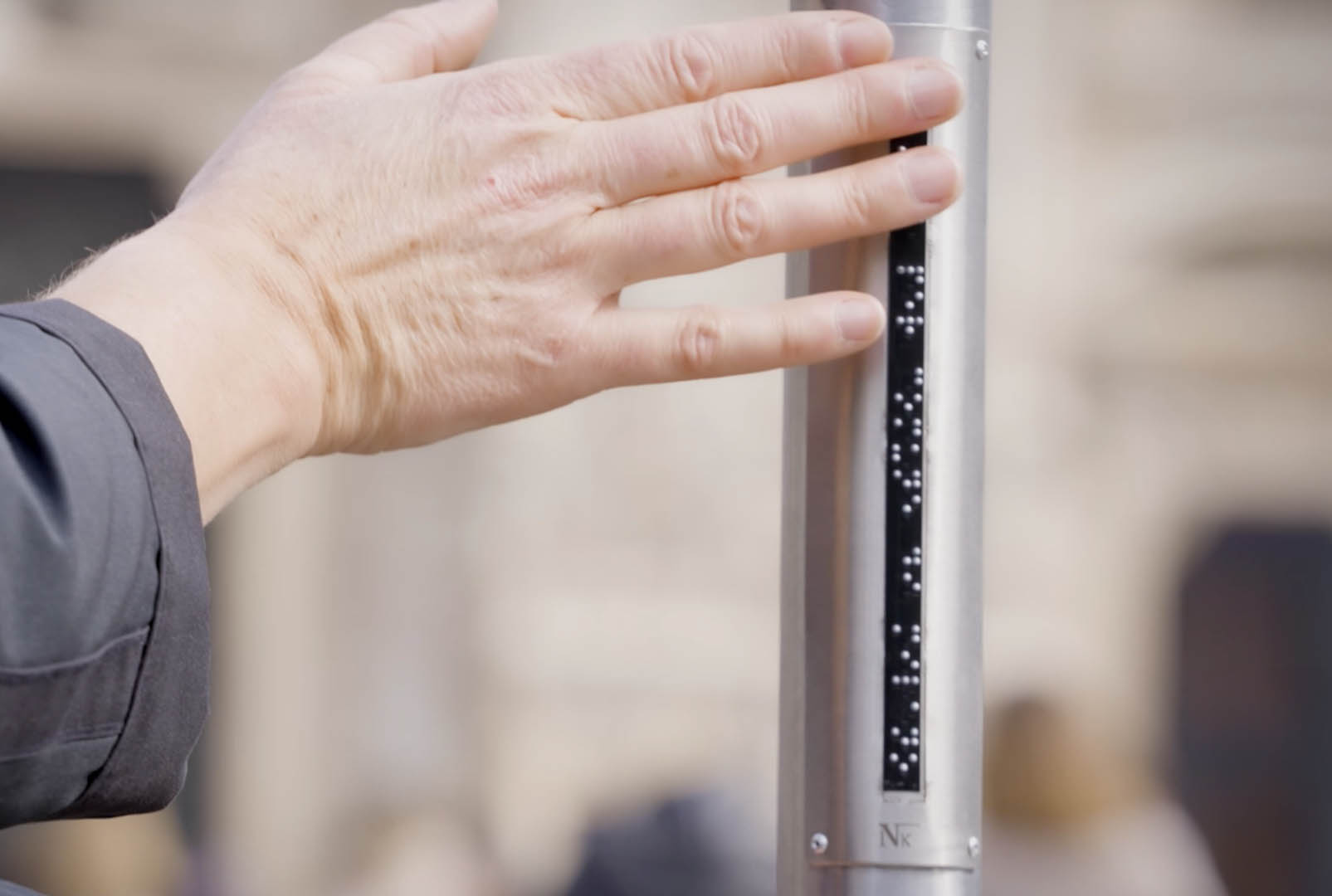

Tactile License Plates
To be accessible and to call itself inclusive, a city must offer suitable tools for orientation and recognition of places even for those with sensory and perception problems. For people with visual impairments, orienting themselves in a complex or even unfamiliar environment is critical: streets, squares, and public environments often represent paths in which it is not easy to orient themselves in general, and this is all the more true for the visually impaired, who as of today have very few tools to turn to in order to know their location in the area.
Our cities do not provide many landmarks for people with visual impairments to facilitate mobility and orientation, with the exception of a few street intersections equipped with sound signals near traffic lights and a few short stretches of tactile pavement. Today, cell phones and digital tools can partially direct the visually impaired, but there are some conditions that can adversely affect them, such as the background noise of the road or the battery of the device, which, being energy-consuming and therefore also unsustainable, is drained (or even the inability of the deaf to use these systems).
This lack of facilitation and inclusion could be remedied to some extent by the adoption of “tactile plaques” as an orientation and mobility aid. A “tactile plaque” is a relief plaque that represents the toponymy and conformation of the place where you are. It serves to indicate a route or explain the characteristics of a place by enabling the subject to develop a mental representation of the environment, i.e., a cognitive map .
Such plaques, which can be made of adhesive material or thin sheets of soft metal printed in the Braille alphabet, could be applied with great ease to all municipal sign posts, which are not only objects already on all sidewalks but are also immediately detectable by the visually impaired through the tilting of technical walking aids (cane for the blind).
“Tactile signs” could be a useful device to promote the accessibility and usability of public places or places open to the public, urban spaces and pedestrian paths according to the provisions of Presidential Decree No. 503 of July 24, 1996. In detail, regarding tactile signage intended for people with visual impairments, the reference is the UNI 8207 standard, which contains information on the height of the Braille character, raised letters and symbols used in tactile maps.